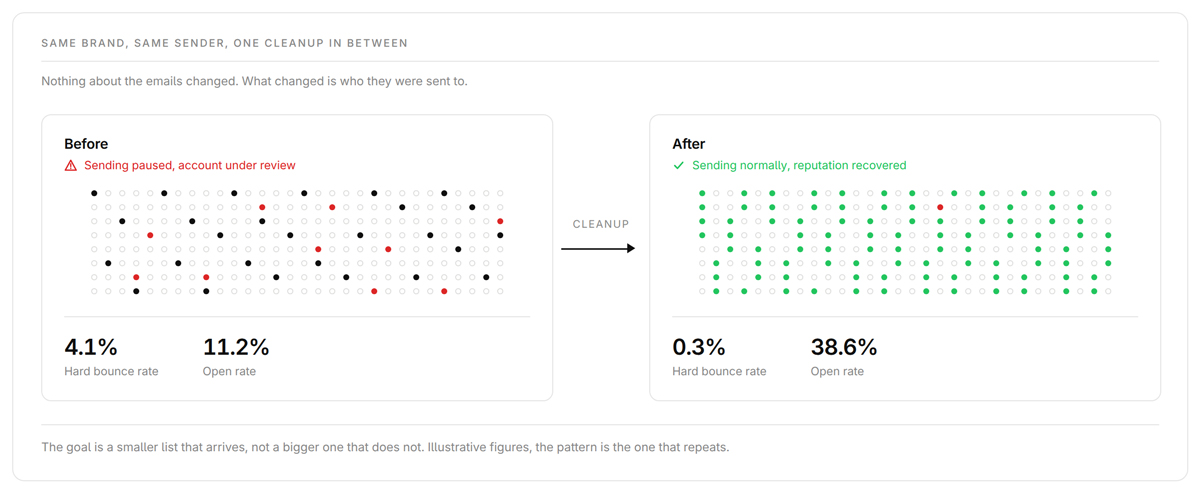
Die meisten Versender warten zu lange. Wenn die lauten Signale kommen, sitzt der Schaden schon in deiner Absenderreputation.
Googles Obergrenze für Spam-Beschwerden liegt bei 0,30%, und 0,10% ist der Wert, den du unterschreiten solltest [2].
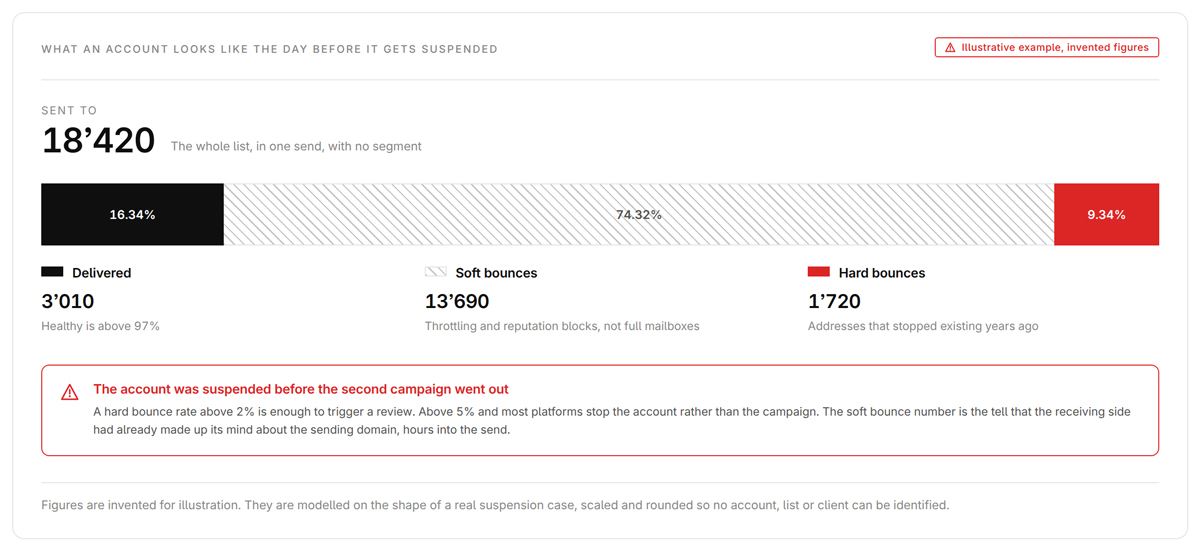
Die Rechnung ist der kleinste Teil davon. Der erste Kostenpunkt ist das Risiko einer Sperrung. Brevo veröffentlicht seine Auslöser, eine Hard-Bounce-Rate über 2%, eine Abmelderate über 1% oder eine Beschwerderate über 0,2% auf den jüngsten Sendungen [5], und eine alte Liste reisst den ersten davon in einer einzigen Kampagne. Dieser Beschwerde-Auslöser liegt unter Gmails eigener Grenze, deine Plattform stoppt dich also, bevor Google es tut. Ein gesperrtes Konto kostet dich jede Sendung, die in dem Monat geplant war.
Der zweite Kostenpunkt ist Volumen, das du bezahlst und das niemand bekommt. Verschick 40’000 E-Mails mit 8’000 toten Adressen in der Datei, und du hast 8’000 Sendungen ins Leere gekauft.
Der dritte ist der, den Versender übersehen. Bounces und Beschwerden aus totem Gewicht ziehen die ganze Versanddomain nach unten, und die Abonnenten, die deine E-Mail wollen, finden sie plötzlich im Spam. Du verlierst nicht die schlafenden Kontakte, du verlierst die guten.
Klaviyo und Mailchimp stellen beide die Verrechnung ein, sobald ein Kontakt gesperrt oder als bereinigt markiert ist [19]. Gegen all das ist Bereinigen billig, ein paar hundert Franken für 50’000 Kontakte.
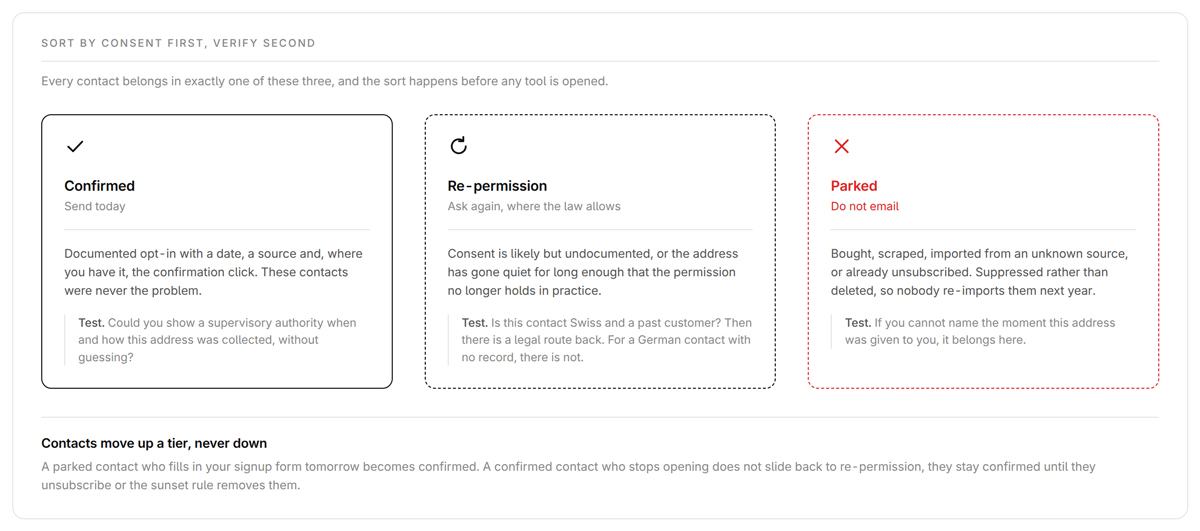
Bevor du ein Verifizierungstool anfasst, sortierst du jeden Kontakt in einen von drei Töpfen. Das ist der Schritt, der verhindert, dass eine Re-Permission-Mail an Kontakte geht, die du nie anschreiben durftest.
| 🟢 | 🟡 | 🔴 |
|---|
Dokumentiertes Double Opt-in | Aktiv, Einwilligungsnachweis dünn | Keine verteidigbare Einwilligung |
| Nochmals fragen, wo es rechtlich geht | |
| Geht in einen eigenen Flow | |
Double Opt-in heisst, dass der Abonnent die Anmeldung durch einen Klick auf einen Link in einer separaten E-Mail bestätigt hat. Es ist in beiden Ländern der Standardnachweis für die Einwilligung, und die Schweizer Seite habe ich in [Double Opt-in in der Schweiz](https://sakto.co/de/double-opt-in-schweiz/) im Detail behandelt.
Zwei Aufgaben vor allem anderen. Miss, was kaputt ist, damit du die Erholung später belegen kannst, und entferne die Zeilen, für deren Verifizierung du sonst doppelt bezahlst.
Zieh dir die Bounce-Rate, aufgeteilt in hart und weich, die Beschwerderate pro Kampagne, Öffnungs- und Klickraten im Zeitverlauf, Abmeldungen und das Netto-Listenwachstum über die letzten drei bis sechs Monate. Mach einen Screenshot davon und notier das Datum.
Dann setz eine Bounce-Regel, denn die meisten Versender haben eine für Hard Bounces und keine für Soft Bounces. Hard Bounces fliegen beim ersten raus, Soft Bounces nach drei aufeinanderfolgenden an dieselbe Adresse. Das ist wichtig, weil Schweizer Geschäftspost auf Infomaniak, Hostpoint und Microsoft-365-Tenants mit Greylisting- und Mailbox-voll-Codes weich bounct, und die lösen sich beim zweiten Versuch auf. Ich habe letztes Jahr ein Konto übernommen, in dem die vorherige Agentur jeden Soft Bounce als tot entfernt hatte. Rund ein Fünftel wäre beim zweiten Versuch zugestellt worden.
Dann kommt die Deduplizierung. Leerzeichen entfernen, die Domain kleinschreiben, Datensätze zusammenführen, die sich über Importe hinweg eine Adresse teilen, und bei Gmail Punkt-Varianten und Plus-Adressierung zusammenziehen, denn manuel+shop@gmail.com und manuel@gmail.com sind bei Google ein Postfach und in deiner Datenbank zwei Zeilen. Das gilt für Gmail, nicht für bluewin.ch oder GMX. Beim Zusammenführen gewinnt das älteste dokumentierte Double Opt-in.
💡 Tipp Bei Lauvette haben unsere Gewinnspiel-Kampagnen die Liste schnell wachsen lassen und unordentlich hinterlassen. Als wir die Adressen normalisiert haben, war knapp ein Zehntel der Datei dieselben Leute, die zweimal teilgenommen hatten. Es ist der billigste Schritt im ganzen Prozess und der einzige, der eine kontaktbasierte Rechnung noch am selben Tag kleiner macht.
Das sind die Segmente, an die du beim Aufwärmen in Schritt 8 sendest, bau sie also jetzt. Ich nutze fünf Bänder. Aktiv hat in den letzten 30 Tagen geöffnet oder geklickt, Frisch in 30 bis 90 Tagen, Kühl in 90 bis 180, Kalt in 180 bis 365, Schlafend seit über einem Jahr gar nicht mehr. Die meisten Kontakte auf den Listen, die ich übergeben bekomme, landen in Kalt oder Schlafend. Das ist, was ich in Audits sehe, keine veröffentlichte Zahl.
Gewichte Klicks höher als Öffnungen. Seit iOS 15 lädt Apple Mail Privacy Protection externe Inhalte über Apples Proxy, der Zählpixel feuert also, ob jemand die Mail gelesen hat oder nicht [24].
Die Verifizierung sagt dir, welche Adressen noch echt sind. Ich nutze Bouncer, USD 8 pro 1’000 Adressen im Pay-as-you-go [20]. Ausschlaggebend war das Hosting, nicht die Genauigkeit. Es gibt keinen glaubwürdigen unabhängigen Genauigkeits-Benchmark, ich lese also jede Trefferquoten-Behauptung eines Anbieters als Marketing.
Tools zum Bereinigen der E-Mail-Liste im Vergleich
| Tool | | | |
|---|
| | Ja, EU-Rechenzentren, unterzeichneter AVV, Löschung nach 60 Tagen [20] | |
| | | |
| | Nein, in den USA gehostet | |
| NeverBounce | | Nein, in den USA gehostet | |
| Kickbox | | Nein, in den USA gehostet | |
Wenn EU-Datenhaltung keine Bedingung ist, sind die drei US-Tools in Ordnung.
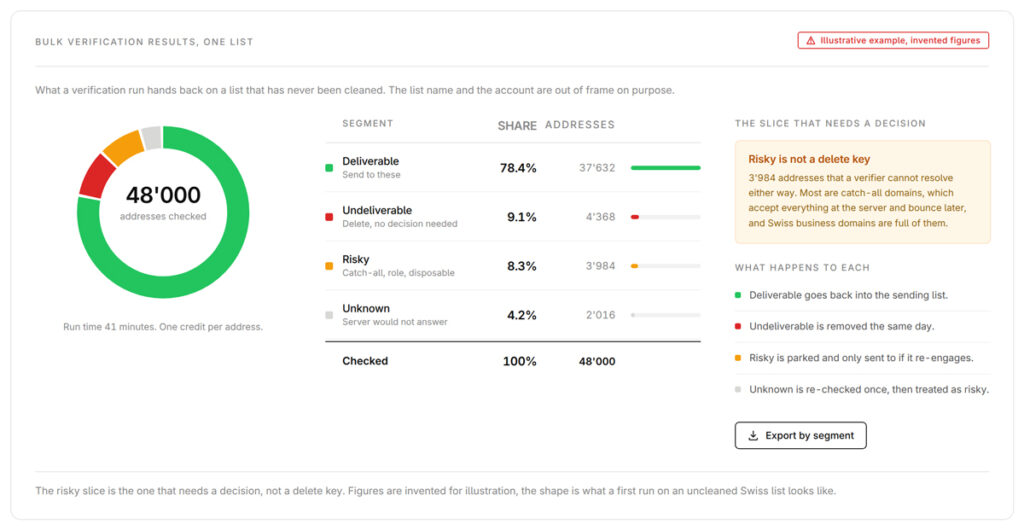
Unzustellbare und Wegwerfadressen fliegen sofort raus, Unbekannt bekommt nach 24 Stunden einen zweiten Versuch, und Rollenadressen wie info@ und sales@ bekommen eine eigene Gruppe, weil dort mehr Beschwerden anfallen.
Es gibt drei Arten von Spam Traps, und sie bedeuten Unterschiedliches [17]. Eine Pristine Trap gehörte nie einer Person, wer eine trifft, hat also eine gekaufte oder abgegriffene Liste, und das Blocklisting-Risiko ist hier am höchsten. Eine Recycled Trap ist ein einst echtes Postfach, das der Anbieter nach mindestens 12 Monaten Inaktivität wieder eingezogen hat, und Rollenadressen werden oft dazu, wenn die Person dahinter geht. Eine Typo Trap ist eine falsch geschriebene Domain, die einzige Kategorie, die ein Verifizierungstool zuverlässig erwischt. Deshalb verifizierst du vor der Reaktivierung und nie danach, denn Validity nennt genau die Reaktivierungssendungen an alte Listen als das, was die recycelten hochspült [17].
Catch-all braucht eine Entscheidung. So eine Domain nimmt jede Adresse an, kein Verifizierungstool kann also bestätigen, dass das Postfach dahinter existiert. ZeroBounce hat über die 11 Milliarden Adressen, die 2025 durch das Tool liefen, 9% als Catch-all eingestuft [1], und auf einer Schweizer B2B-Liste rechne mit mehr, weil Schweizer KMU-Domains auf Tenants liegen, die standardmässig alles annehmen.
⚠️ Achtung Lösch Catch-alls nicht, und send ihnen nicht das volle Volumen. Pack sie in ein eigenes Segment, schick in Chargen von ein paar hundert, beobachte die Bounce-Rate dieses Segments und stuf sie danach hoch oder sperr sie.
Die Verifizierung sagt dir, ob eine Adresse funktioniert. Ob du sie anschreiben darfst, sagt sie nicht, und in der Schweiz und in Deutschland ist die zweite Frage die, die Geld kostet.
Für jeden Kontakt, der übrig bleibt, hältst du die Quelle fest, den Zeitstempel der Anmeldung, die IP-Adresse, wenn du sie hast, und die Methode, also Single Opt-in, Double Opt-in, Offline-Erfassung oder Kauf. Wenn du nicht alle vier beantworten kannst, gehört der Kontakt nicht in die Stufe Bestätigt. Wenn dich jemand angeht, und in Deutschland tut das irgendwann jemand, ist der Einwilligungsnachweis die ganze Verteidigung.
Die meisten geerbten Datenbanken tragen ausserdem einen Topf, den niemand benennt, Leute, die das Formular abgeschickt und den Bestätigungslink nie geklickt haben. Die deutsche Praxis behandelt so einen Datensatz als Daten, deren Zweck nach Art. 17 Abs. 1 lit. a DSGVO weggefallen ist, mit rund drei Wochen als angemessenem Fenster [16], lösch ihn also über eine automatische Regel und schick die Bestätigung nie Monate später erneut.
der Einwilligungsnachweis die ganze Verteidigung.
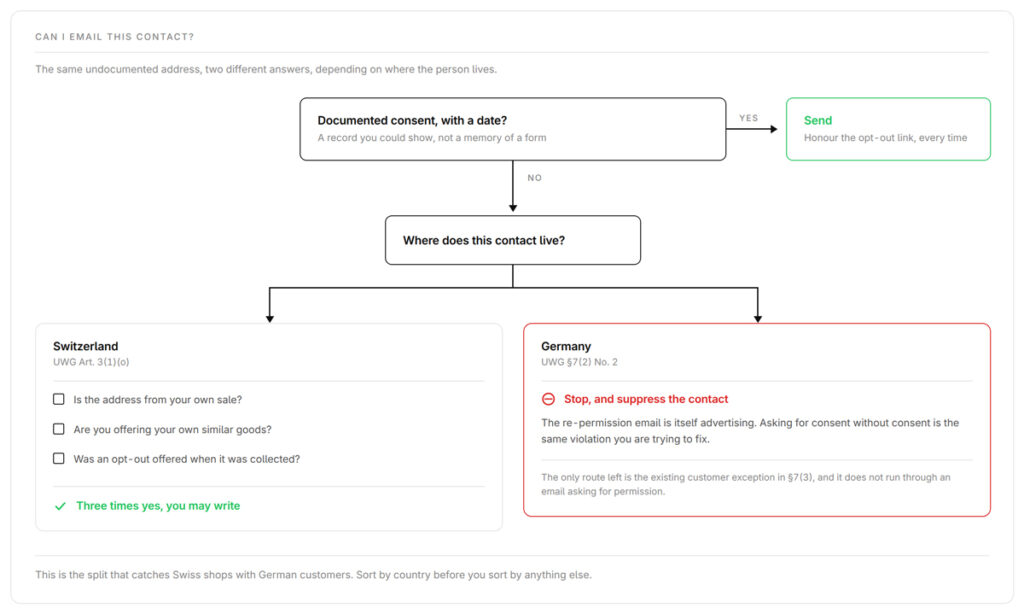
Das ist der Schritt, den fast jeder englischsprachige Artikel auslässt. Beide Länder haben ein Gesetz namens UWG, das Gesetz gegen den unlauteren Wettbewerb, und setzen es auf entgegengesetzte Weise durch.
Das Schweizer UWG Art. 3 Abs. 1 lit. o macht es rechtswidrig, Massenwerbung per Telekommunikation ohne vorherige Einwilligung, ohne korrekte Absenderangabe oder ohne eine einfache und kostenlose Ablehnungsmöglichkeit zu versenden, und alle drei Pflichten gelten zusammen [7]. Die Ausnahme ist eng. Wenn du die Adresse beim eigenen Verkauf erhalten und die Ablehnungsmöglichkeit dort ausgewiesen hast, darfst du eigene ähnliche Waren ohne separate Einwilligung bewerben.
🇨🇭 Schweizer Regel Zwei Korrekturen zu dem, was du fast überall sonst liest. Das Schweizer Recht kennt keine B2B-Ausnahme für E-Mail [7]. Und die Schweizerische Lauterkeitskommission hat entschieden, dass die Automatisierung und nicht die Empfängerzahl aus Werbung einen Massenversand macht [10], alles, was eine E-Mail-Plattform verlässt, ist also Massenwerbung, so wenige Leute es auch bekommen.
🇩🇪 Deutsche Regel §7 Abs. 2 Nr. 2 UWG verlangt in Deutschland eine vorherige ausdrückliche Einwilligung für Werbung per E-Mail, ebenfalls ohne B2B-Ausnahme. §7 Abs. 3 UWG nimmt Bestandskunden nur dann aus, wenn vier Bedingungen zusammen erfüllt sind. Die Adresse stammt aus einem Verkauf, die Werbung betrifft eigene ähnliche Waren, der Kunde hat nicht widersprochen, und der Widerspruchshinweis wurde bei der Erhebung gegeben und in jeder Nachricht wiederholt [22].
Die Regeln liegen nah beieinander. Bei der Durchsetzung gehen die beiden Länder auseinander.
|
🇨🇭 Schweiz |
🇩🇪 Deutschland |
|
|
Es gibt kein Abmahnsystem
|
Eine ganze Industrie. §13 Abs. 3 UWG macht dich für die Kosten des Absenders haftbar
|
|
|
Art. 23 UWG, strafbar, nur auf Antrag [8]
|
Unterlassung plus Kosten, EUR 3’000 Streitwert pro E-Mail [21]
|
|
|
Bis zu CHF 250’000 gegen die natürliche Person, revDSG Art. 60 bis 64 [8]
|
DSGVO-Bussen gegen das Unternehmen
|
Beide Geldbeträge werden weithin falsch wiedergegeben. Die CHF 250’000 hängen an den Pflichten aus dem revidierten Datenschutzgesetz (revDSG) und nicht am Spam, und sie treffen die verantwortliche natürliche Person statt das Unternehmen, umgekehrt als bei der DSGVO [8]. Die deutschen EUR 3’000 sind ein Streitwert, also der Wert, über den die Gebühren berechnet werden, vom KG Berlin für eine einzelne unerwünschte E-Mail festgesetzt [21], eine erste Abmahnung kostet also ein paar hundert Euro, und eine zweite Sendung eskaliert.
Die Schweizer Durchsetzung ist real, aber klein. Ein Strafbefehl im Kanton Luzern von 2019 betraf 22 Werbe-E-Mails an eine Person, die Jahre zuvor widersprochen hatte, und die Strafe lag bei CHF 250 Busse, CHF 660 Kosten und 15 bedingten Tagessätzen [9]. Eine Grössenordnung unter dem deutschen Risiko.
Jetzt der Teil, der über deine deutschen Kontakte entscheidet. Wenn einer keine gültige Einwilligung hat, darfst du ihn nicht anschreiben, um danach zu fragen. Das OLG München hat entschieden, dass eine E-Mail, die zur Bestätigung einer Newsletter-Anmeldung auffordert, selbst Werbung ist und unter das Verbot fällt [11]. Das ist eine oberlandesgerichtliche Entscheidung und keine gefestigte BGH-Rechtsprechung, und sie wird in der deutschen Literatur kritisiert, angreifbar ist sie also, aber das Risiko ist hoch genug, dass Sperren der richtige Zug ist.
Eine neuere Entscheidung verschiebt die Linie wieder zu deinen Gunsten. Im November 2025 hat der EuGH entschieden, dass die Angabe einer E-Mail-Adresse im Austausch gegen eine kostenlose digitale Leistung als Erhalt im Zusammenhang mit einem Verkauf zählt, die Bestandskunden-Ausnahme reicht also weiter, als die meisten Versender angenommen haben [14]. Prüf, ob §7 Abs. 3 UWG einen Kontakt abdeckt, bevor du ihn als nicht anschreibbar parkst. Was du dorthin schickst, bleibt so nackt wie ein Passwort-Reset. Das LG Stendal hat entschieden, dass ein Logo und eine Begrüssungszeile in einer Double-Opt-in-Bestätigung diese zu rechtswidriger Werbung machen, und das KG Berlin hat dasselbe für einen zweizeiligen Werbe-Footer auf einer ansonsten legitimen Geschäfts-E-Mail entschieden [12].
Eine gute Nachricht. Der BGH hat im Januar 2025 entschieden, dass eine einzelne unerwünschte E-Mail für sich genommen keinen Schadensersatzanspruch nach Art. 82 DSGVO begründet, weil die klagende Person einen echten Kontrollverlust darlegen muss [13]. Der Unterlassungsanspruch und die Abmahnkosten bleiben davon unberührt.
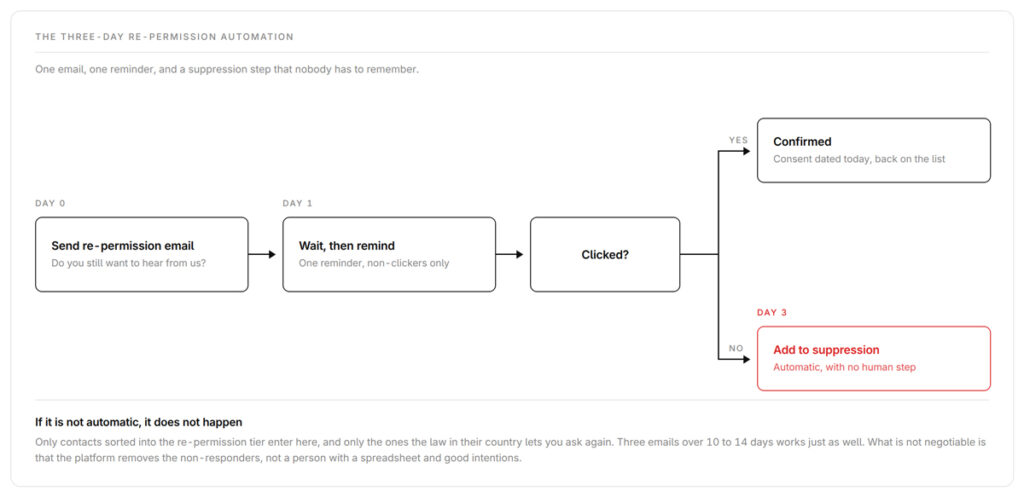
Sobald du weisst, welche Kontakte du rechtlich fragen darfst, ist die Mechanik bewusst langweilig.
| |
|---|
| Re-Permission-Mail mit der Frage, ob der Kontakt deine E-Mails weiterhin will |
| Eine Erinnerung an alle, die nicht geklickt haben |
| Wer nicht reagiert hat, wandert automatisch in die Sperrliste |
In Brevo, Klaviyo, ActiveCampaign und Mailchimp funktioniert das gleich, und drei Mails über 10 bis 14 Tage sind auch in Ordnung. Nicht verhandelbar ist, dass die Automation die Nichtreagierenden sperrt und nicht jemand, der daran denkt.
Es gibt keinen glaubwürdigen veröffentlichten Benchmark für Re-Confirmation-Raten, misstrau also jeder Zahl, die dir genannt wird. Ein niedriger Rücklauf ist kein Scheitern. Die Leute, die nicht klicken, haben auch nicht gekauft.
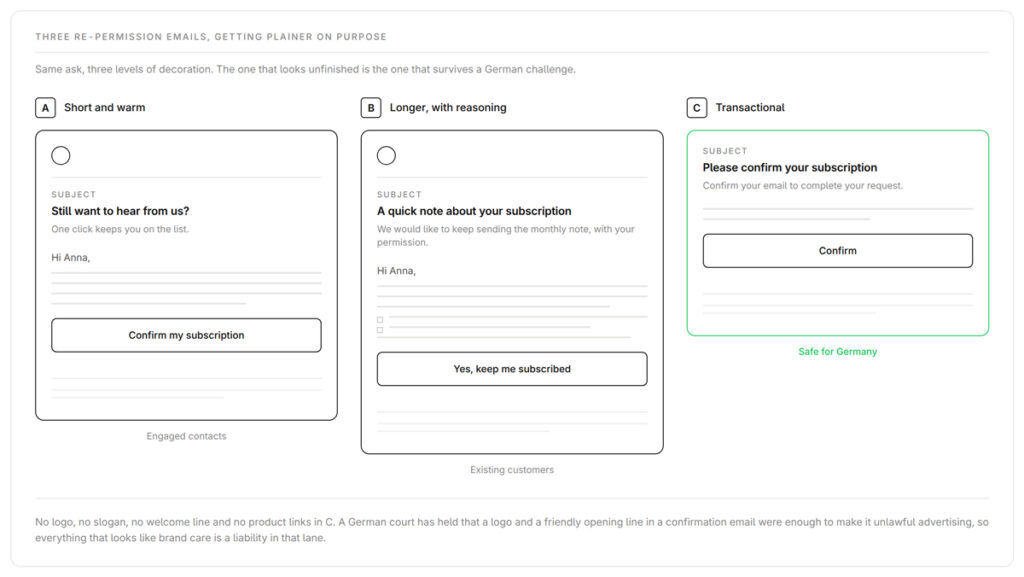
Alle drei tragen dieselben Grundelemente. Klare Absenderidentität, eine schlichte Angabe des Zwecks, eine Abmeldung mit einem Klick, ein Link auf die Datenschutzerklärung, und nichts Werbliches.
| | |
|---|
| Aktive Kontakte, dünner Einwilligungsnachweis | Nur dort, wo eine Einwilligungsgrundlage besteht |
B, länger, mit Begründung | Kunden, die du neu verankern willst | Nur mit vorheriger Grundlage, Nutzenpunkte rein informativ |
| Alles Richtung Deutschland | Der einzige Stil, den ich senden würde |
Betreff: Willst du weiter von uns hören? Vorschautext: Ein Klick, und du bleibst auf der Liste.
Hallo [Vorname],
Wir räumen unsere Liste auf, damit wir nur noch Leuten schreiben, die von uns hören wollen. Wenn das auf dich zutrifft, klick unten, und es ändert sich nichts. Wenn wir nichts hören, hören wir still auf.
[Anmeldung bestätigen]
[Rechtlicher Firmenname, Adresse] · [Datenschutzerklärung] · [Abmelden]
Betreff: Kurz zu deinem Abo Vorschautext: Wir würden dir gern weiter [nützliche Sache] schicken, mit deiner Erlaubnis.
Hallo [Vorname],
Du bekommst das, weil du vor einiger Zeit [bei uns gekauft / dich angemeldet] hast, und wir fragen lieber, als anzunehmen. Bestätige unten, und du bekommst weiter [informativer Nutzenpunkt] und [informativer Nutzenpunkt]. Tu nichts, und du fällst automatisch von der Marketingliste.
[Ja, ich bleibe dabei]
[Rechtlicher Firmenname, Adresse] · [Datenschutzerklärung] · [Abmelden]
Betreff: Bitte bestätige dein Abo Vorschautext: Bestätige deine E-Mail-Adresse, um deine Anfrage abzuschliessen.
Bitte bestätige mit einem Klick unten, dass du E-Mails von [Firma] erhalten möchtest.
[Bestätigen]
[Rechtlicher Firmenname, Adresse] · [Datenschutzerklärung] · [Abmelden]
Sonst nichts in C. Kein Logo, kein Slogan, keine Begrüssungszeile, keine Produktlinks [12].
Ein Fehler, den ich mehr als einmal gesehen habe. Liste bereinigen, dann volles Volumen aus einer stillen Domain senden, und die Provider lesen den Sprung als Spammer.
Steiger stattdessen. Woche 1 geht an die aktivsten 25% der bereinigten Liste, Woche 2 an 50%, Woche 3 an 75%, Woche 4 an alle. Halt Bounces unter 2%, Beschwerden unter 0,1% und das Muster gleichmässig.
Bring die Authentifizierung in Ordnung, während du hochfährst. Seit dem 5. Mai 2025 verlangt Microsoft SPF, DKIM und DMARC, die drei E-Mail-Authentifizierungseinträge, von allen, die 5’000 oder mehr Nachrichten pro Tag an outlook.com, hotmail.com und live.com senden. Nicht konforme Post geht in den Junk-Ordner, und Microsoft kündigt eine glatte Abweisung an, ohne ein Datum zu nennen [4]. Gmail und Yahoo verlangen dasselbe seit Februar 2024 [2]. Starte DMARC mit p=none, lies die Reports, geh dann auf p=quarantine und p=reject.
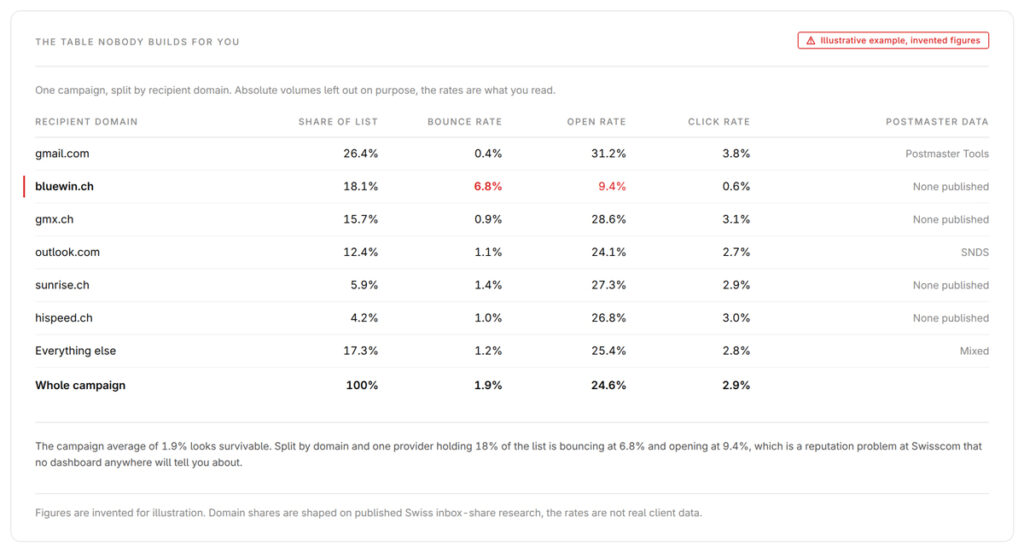
Jeder Artikel zu diesem Thema sagt dir, du sollst die Google Postmaster Tools beobachten. Bei einer Schweizer Liste bleibt damit die Mehrheit deiner Empfänger unsichtbar, und das ist der grösste einzelne Grund, warum ein in den USA geschriebener Bereinigungsprozess hier danebengeht.
📊 Kurzer Fakt In der Deutschschweiz macht Gmail 26% der privaten Postfächer aus. Bluewin (Swisscom) liegt bei 18,5%, GMX.ch bei 16,1%, Microsoft bei 12,9% und Sunrise bei 5,6% [6]. Bluewin, GMX.ch und Sunrise zusammen sind rund 40%, und keiner davon veröffentlicht ein Postmaster-Dashboard.
Zwei Einschränkungen. Die Erhebung ist von 2022 und wurde von United Internet Media in Auftrag gegeben, dem Eigentümer von GMX. Die Richtung stimmt trotzdem, auch wenn sich die Anteile verschoben haben.
Schweizer Messung musst du dir also bauen statt nachschlagen. Google deckt rund ein Viertel deiner Liste ab, Microsofts Zustellbarkeits-Dashboard SNDS ein weiteres Achtel, und für den Rest teilst du deine eigenen Bounce- und Engagement-Daten nach Empfängerdomain auf, bluewin.ch, gmx.ch, hispeed.ch, sunrise.ch und bluemail.ch, und beobachtest diese Spalten einzeln. Ein Reputationsproblem bei Swisscom taucht in deinen eigenen Daten auf oder gar nicht.
Zwei Hinweise zu den Dashboards, die du hast. Google stellt die Ansichten Domain Reputation und IP Reputation in der alten Oberfläche der Postmaster Tools ein, ohne ein Datum zu nennen [3]. Und Yahoos Sender Hub zählt im Nenner seiner Beschwerderate nur die in den Posteingang zugestellten Nachrichten, deshalb liest sich diese Zahl höher als die deiner Plattform [23].
Bei der jährlichen Zerfallsrate von 23%, die ZeroBounce 2025 über 11 Milliarden Adressen gemessen hat, verliert eine Liste mit 50’000 Kontakten rund 2’800 pro Quartal [1].
Meine Regel ist, dass die Frequenz der Versandfrequenz folgt und nicht der Listengrösse. Wer wöchentlich sendet, kommt mit einer Verifizierung pro Quartal aus, weil das eigene Bounce-Protokoll früh warnt. Wer monatlich oder seltener sendet, erfährt vom Zerfall viermal langsamer und verifiziert deshalb vor jeder zweiten Kampagne.
Die andere Hälfte ist Prävention. Leg eine Verifizierung auf das Anmeldeformular, damit Tippfehler-Domains wie gmial.com und blueiwn.ch gar nicht erst in die Liste kommen. Ergänz Honeypot-Felder und eine Bot-Prüfung. Bevor jemand die Abmeldebestätigung erreicht, bietest du eine kleinere Option an. Monatlich statt wöchentlich, oder ein Thema statt aller. Ein heruntergestufter Abonnent ist immer noch ein Abonnent, und wer diese Option nicht findet, greift zum Spam-Knopf. Dann setzt du eine Sunset-Policy, damit inaktive Kontakte von selbst gehen. Nur 24% der Versender haben eine [18].
Das Sunset-Fenster folgt derselben Logik, plus deinem Kaufzyklus. Wer täglich sendet, setzt den Schnitt bei 60 bis 90 Tagen ohne Reaktion, wer wöchentlich sendet bei 90 bis 180, wer monatlich oder seltener sendet bei 180 bis 365. Bau drei Ausnahmen in die Automation ein, sonst sperrt sie dir gute Kunden. Wer letzten Monat gekauft hat, ist beschäftigt und nicht abgewandt, verläng also dessen Fenster. Hochwertige und Enterprise-Kunden bekommen eine menschliche Entscheidung, nie die Regel. Und bekannte Saisonalität ist keine Abwendung, denn die Kunden eines Schweizer Skishops werden jeden Juli still.
Wenn sich jemand abmeldet, hart bounct oder eine Re-Permission-Mail ignoriert, lösch die Person nicht. Sperr sie. Löschen verliert den Nachweis, dass du die Abmeldung beachtet hast, und lässt dieselbe Adresse beim nächsten Import wieder hereinspazieren.
In Deutschland erwarten die Aufsichtsbehörden genau das. Die Datenschutzkonferenz hält fest, dass Werbe-Sperrdateien nach Art. 21 Abs. 3, Art. 17 Abs. 3 lit. b und Art. 6 Abs. 1 lit. f DSGVO zulässig sind [15]. Die Schweiz hat dazu keine vergleichbare Orientierungshilfe, und das sage ich dir lieber, als eine zu erfinden. Art. 6 Abs. 4 revDSG verlangt, dass Daten vernichtet werden, sobald sie nicht mehr nötig sind, aber die Beachtung des Widerspruchs ist selbst ein fortlaufender Zweck, und Art. 31 rechtfertigt sie über das überwiegende private Interesse. Halt den Datensatz minimal, die Adresse und das Datum der Abmeldung.
Eine Sperrliste ist kein Ausschluss pro Kampagne, sondern gilt global über jede Kampagne, jeden Workflow und jedes Tool, aus dem du sendest, und der einzige Weg heraus ist, dass die Person sich selbst wieder anmeldet.
Die Reihenfolge ändert sich, wenn das Konto schon gesperrt ist, und Panik-Bereinigen macht es schlimmer. Send gar nichts, Tests und Entschuldigungsmails eingeschlossen. Lies die Mitteilung und finde heraus, was den Auslöser gedrückt hat, denn ein Bounce-Problem und ein Beschwerde-Problem brauchen verschiedene Korrekturen. Verifizier die ganze Liste, dann bau von den aktivsten 10 bis 20% wieder auf, in Sendungen von 500, dann 1’000, dann 2’500. Die Reputation einer Domain repariert sich langsam, plan also in Wochen statt in Tagen.
Manche Listen brauchen das nicht. Lass es, wenn du unter 1’000 Kontakte hast und alle reagieren, wenn die Liste jünger als sechs Monate ist, oder wenn Bounces schon unter 1% und Beschwerden unter 0,05% liegen. Lass es auch mitten in einem Launch, und komm danach zurück.
Ein Chaos geerbt, oder ein Jahr lang sinkende Öffnungsraten beobachtet, ohne zu wissen warum? Genau das machen wir bei sakto. Wir übernehmen die Diagnose, die Verifizierung, die Aufteilung nach Rechtsraum, den Aufbau der Re-Permission und das Aufwärmen, damit am Ende eine kleinere, gesündere Liste steht, die Schweizer Postfächer erreicht und in beiden Ländern rechtlich hält.
sakto ist eine Schweizer E-Mail-Marketing-Agentur, Brevo-first, gebaut für E-Commerce- und B2B-Versender, die wollen, dass ihre E-Mail funktioniert und auf der richtigen Seite des Schweizer und deutschen Rechts bleibt.
[1] ZeroBounce, Email List Decay Report 2026 (zerobounce.net/email-list-decay) · [2] Google, Email sender guidelines (support.google.com/a/answer/81126) · [3] Google, Deprecation of the old Postmaster Tools interface (support.google.com/a/answer/16594218) · [4] Microsoft Defender for Office 365 Blog, Outlook requirements for high-volume senders, gültig ab 5. Mai 2025 · [5] Brevo Help Center, Why have my account or email campaigns been suspended? · [6] MindTake Research für United Internet Media, Befragung von 1’010 Onlinenutzern in der Deutschschweiz, 24. August 2022 · [7] Schweizer UWG Art. 3 Abs. 1 lit. o, Fedlex SR 241 · [8] revDSG Art. 60 bis 64, in Kraft seit 1. September 2023, EDÖB-Hinweise zu den Strafbestimmungen, und Art. 23 UWG · [9] Strafbefehl Kanton Luzern, berichtet von Steiger Legal, 16. Juli 2019 · [10] Schweizerische Lauterkeitskommission, Entscheid Nr. 172/20 · [11] OLG München, 29 U 1682/12, 27. September 2012 · [12] LG Stendal, 22 S 87/20, 12. Mai 2021, und KG Berlin, 5 U 35/20, 15. September 2021 · [13] BGH, VI ZR 109/23, 28. Januar 2025 · [14] EuGH, C-654/23 Inteligo Media SA gegen ANSPDCP, 13. November 2025 · [15] Datenschutzkonferenz, Orientierungshilfe Direktwerbung, Abschnitt 5.1 · [16] IT-Recht Kanzlei zur Löschung unbestätigter Double-Opt-in-Datensätze, Art. 17 Abs. 1 lit. a DSGVO · [17] Validity, Spam Traps: What They Are and How to Avoid Them, aktualisiert am 29. Oktober 2025 · [18] Sinch Mailgun, State of Email Deliverability 2025, Befragung von mehr als 1’100 Versendern · [19] Klaviyo Help Center, Understanding active profile management, und Mailchimp, About cleaned contacts · [20] Bouncer, GDPR- und Preisseiten (usebouncer.com/gdpr, /pricing) · [21] KG Berlin, 5 W 6/23, 20. Juni 2023 · [22] §7 UWG (dejure.org) · [23] Yahoo, Introducing Insights, Postmaster @ Yahoo Blog, und Spam Resource, 19. Oktober 2025 · [24] Apple Support-Artikel 102289, Mail Privacy Protection
*Dieser Artikel ist allgemeine Information, keine Rechtsberatung. Schweizer und deutsches E-Mail-Recht ist einzelfallabhängig. Kläre es mit einer qualifizierten Fachperson, bevor du handelst.*