
21 min read
Post-Purchase Email Flow: How to Win the Second Order
The second order is the most profitable one, and almost no shop has a flow that asks for it. Here is the sequence I build.
Author Name
Lorem Ipsum is simply dummy text of the printing and typesetting industry.
SHARE


Why the second order matters most
The first order is where you spend money. The second is where you start making it.
The acquisition cost is already paid, and the trust exists because the first parcel arrived and did what it promised. The advantage compounds with every order after that. Bluecore’s data shows a shopper is 15.07% more likely to buy again after one purchase, 25.59% after two, 50.47% after six [3].
📊 Quick fact Bluecore put the average repeat purchase rate at 16.5% [1]. A separate 2026 study of 156’110 customers put it at 18.8% [2]. So roughly five out of every six people you paid to acquire never come back, and most of them were never asked to.
Nobody is filling that gap either. Omnisend found abandoned cart and welcome messages alone drove 76% of all automation-generated orders [6], and both fire before the purchase. The post-purchase window is what is left over, which makes it the cheapest place in most accounts to find revenue.
What counts as a post-purchase email flow, and what does not
A shop tells me their post-purchase email is covered, and what they mean is the order confirmation and the shipping notification.
Those are transactional emails, and I used to dismiss them as receipts. The data made me stop. Shipping confirmations open at 62.67% and convert at 2.19%, worth $3.08 per email sent, against a 0.08% conversion rate on ordinary campaigns [5]. Your receipts are the best-read emails your shop will ever send.
So build them properly. The tracking link goes at the top, above the order summary, because tracking is the reason the email got opened. Under it, one line saying what happens next and when. Under that, a link to your how-to-use or setup content, which is the cheapest return-reducer you own. What does not belong in a receipt is a discount code, a product recommendation or a cross-sell block. Partly because they push the tracking link down the page, and partly because of what they do to the email legally.
That still does not make a receipt a flow. A receipt answers a question the customer already has. A post-purchase email flow is a sequence of marketing emails that works toward the next order, and the line between the two is a consent line. Transactional consent and marketing consent are not the same permission. A receipt can go to anyone who ordered. Anything that sells, asks for a review, or asks how they are getting on is advertising, and in Germany bolting it onto a receipt does not change what it is [8] [11].
The sequence, email by email
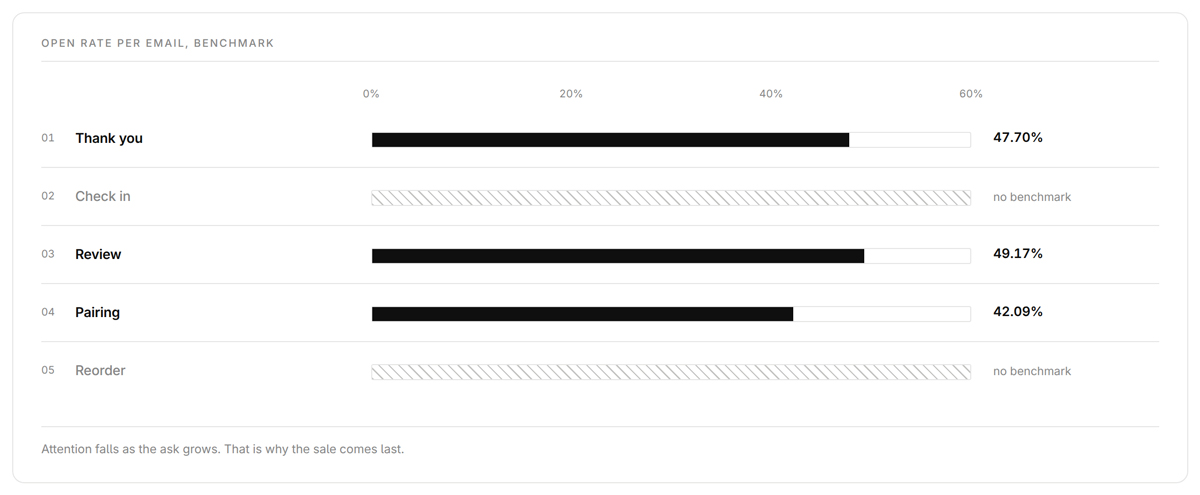
Five emails, each with one job. I adjust the count and the copy per shop, but the spine stays the same. The benchmarks beside them come from one dataset and one period, so they compare cleanly [5], and that dataset has no separate row for a check-in or a replenishment email, so emails 2 and 5 carry none and get judged against your own baseline instead.
- Email 1, the thank-you: a day or two after delivery, not after the order. It confirms the buyer chose well and sets up what is coming. No offer. This email builds the trust the rest of the flow spends. Benchmark: 47.70% open, 4.12% click [5]. Subject: "Thanks for your order, here is what happens next".
- Email 2, the check-in: about a week after delivery, once they have used the product. It catches a problem before it becomes a return and opens a reply channel, which helps your sender reputation. Fold your how-to-use content in here. Subject: "How are you getting on with it".
- Email 3, the review request: timed to when they have formed an opinion, which is category-dependent. Roughly 21 days for hard goods like electronics, 14 for apparel and cosmetics, 7 for seasonal items [15]. Benchmark: 49.17% open, 4.29% click, $1.14 per email [5]. Reviews feed your next customer's first order, so this one pays for acquisition while living in retention. Subject: "Would you write a short review".
- Email 4, the pairing: now, and only now, the first real suggestion. Beans after the grinder. The care kit after the jacket. Benchmark: 42.09% open, 3.02% click, $0.95 per email [5]. Subject: "What most people order next".
- Email 5, the reorder: timed to when the product runs out or the season turns. For consumables this is the most valuable email in the flow. For durables it becomes a next-category suggestion. Subject: "Time to reorder".
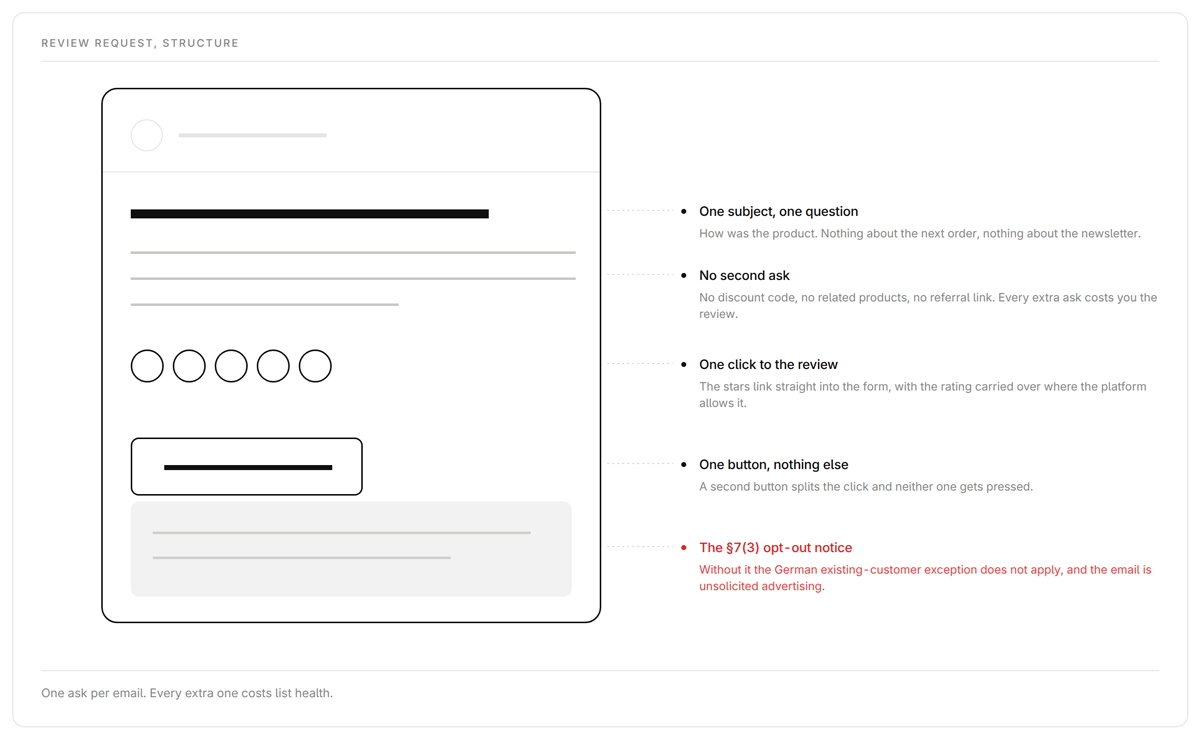
Keep the selling out of the first three emails. There is a measured reason for that order. Unsubscribe rates run 0.30% on the shipping confirmation against 0.89% on the cross-sell [5], the highest of any automation type in that dataset, while the pairing email earns the least of the post-purchase set. The ask is expensive in list health. Spend it once, and spend it late.
A referral or loyalty invitation rides inside email 3 or 4 rather than earning a sixth step, because it is one more ask in a window where every ask is priced in unsubscribes.
Timing it to the product, and to the delivery
The sequence is a shape, not a schedule. The schedule comes from how fast your customers come back and how fast your parcels arrive.
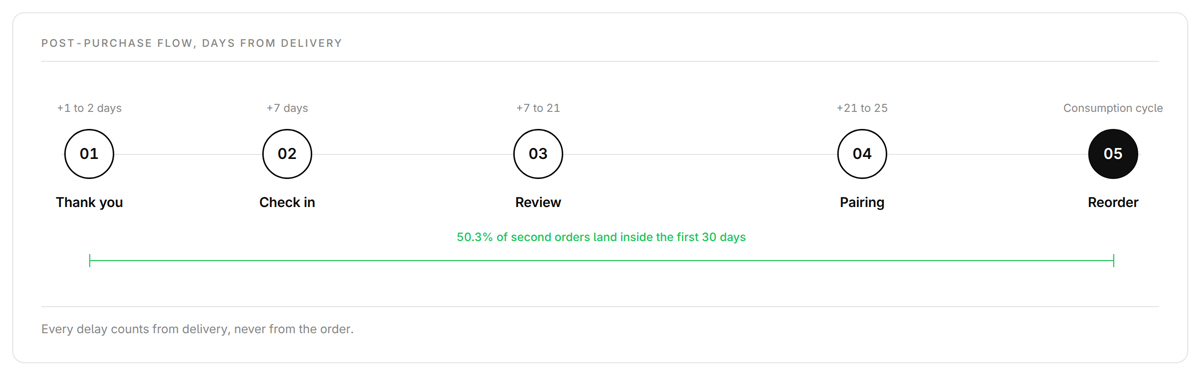
Across 40’397 repeat buyers, 6.3% of second orders happen the same day as the first, 15.9% within a week, 50.3% within 30 days and 76.4% within 90 [2]. Half the opportunity is gone by day 30, so the sequence should finish inside the first month for most shops. Averages mislead you here, because a small tail of buyers returns after 12 or 18 months. Use the median.
E-Mail | Starting delay | Counted from |
|---|---|---|
1 Thank-you | +1 to 2 days | Delivery |
2 Check-in | +7 days | Delivery |
3 Review | +7, +14 or +21 by category | Delivery |
4 Pairing | +21 to 25 days | Delivery |
5 Reorder | Consumption cycle, or +45 for durables | Delivery |
These are starting values, to be replaced by your shop’s own median second-order day.
✋ My honest opinion At Lauvette we set the replenishment delay off the pack size, which felt logical and was wrong for about a year. When we plotted when second orders landed rather than when the product should have run out, the peak was weeks earlier than our email. People reorder when they remember, not when the jar is empty.
The second input is delivery. A fixed delay counted from the order event misfires whenever shipping is slow, and a thank-you that lands before the parcel is worse than no email. Swiss Post A-Post arrives faster than B-Post, and anything crossing the border adds customs clearance you cannot predict. Either trigger email 1 off a delivery webhook, or set the first delay to clear your 90th percentile delivery time rather than your average.
Consumables versus durables
Whether the fifth email is a reorder or something else depends on what you sell, and this is the biggest branch in the flow.
Consumable | Durable | |
|---|---|---|
Examples | Coffee, supplements, skincare, pet food | Furniture, electronics, jewellery, apparel |
Repeat rate [2] | 22% to 44% | 7% to 18% (fashion 12% to 17%) |
Second order is | The same product, 77% of the time across all verticals, 82% to 93% for supplements [2] | A different product |
Email 5 | Reorder at the run-out point | A different category or a complementary item |
Timing signal | Consumption cycle | Season, occasion, browse behaviour |
If you sell consumables and have no replenishment email, that is the first thing I would build, before the welcome flow, before anything. If you sell durables, build the pairing and review emails first and treat the fifth as a seasonal prompt.
Then the flow ends, and that is the part most versions of this leave out. A post-purchase sequence with no exit is a newsletter with extra steps. After the reorder email the contact leaves the flow and moves to your win-back sequence or your normal campaign list. Ninety days is the sensible cut, because 76.4% of second orders have already landed by then [2]. One legal point on that handoff, which I come back to below. Germany’s existing-customer exemption under §7 Abs. 3 UWG rests on the sale you are following up, and it gets weaker the further you travel from it. A win-back to a German buyer who never gave you a marketing opt-in is a different question from email 1, not the same permission stretched thinner.
Splitting the flow so it fits the customer
One linear sequence sent to everybody is the mistake this flow exists to fix. A repeat buyer should not get the same thank-you as a first-timer, and a CHF 900 order does not deserve the same follow-up as a CHF 60 one. Five splits earn their build time.
- First-time versus returning: check lifetime order count at entry. Returning buyers skip the thank-you and the pairing and go straight to reorder timing.
- Order value: a high-value order justifies a human touch, a longer gap before any ask, and often no cross-sell at all.
- Product category: decides which pairing product appears and which consumption cycle sets the reorder delay.
- Shipping country: Switzerland, Germany and Austria are three legal positions, not one.
- Contact language: set a language attribute from the shop locale at checkout, never from the postcode, because Biel/Bienne and Fribourg/Freiburg are bilingual. Split once at the top rather than building the flow four times.
There is a sixth split almost nobody builds. Before emails 3 and 4, exclude anyone with an open support ticket, a requested return, or a refund. Asking someone to publicly rate a product they are packing back into its box turns a private complaint into a one-star review. Set a contact attribute from your helpdesk and check it with a conditional split. I learned that on a Swiss shop where a batch left the warehouse days late and the review request fired on schedule anyway. Five one-star reviews in a week, every one about shipping, none about the product.
Switzerland, Germany and Austria are three different flows
Is a post-purchase review request email legal in Germany? Not without consent, and that is where a Swiss shop shipping across the border gets caught. All three countries have an existing-customer exemption, written into unfair competition law in Switzerland and Germany (both called UWG) and into telecoms law in Austria (TKG), and none of them mean the same thing by it.
| 🇨🇭 Switzerland | 🇩🇪 Germany | 🇦🇹 Austria | |
|---|---|---|---|
Law | UWG Art. 3(1)(o) [7] | §7 Abs. 3 UWG [10] | §174 TKG 2021 [13] |
Conditions | 3 | 4 | 5 |
Notice at checkout | ✅ Required | ✅ Required, and every send | ✅ Required, and every send |
Review request, no consent | Generally fine | 🔴 Ruled unlawful [8] [9] | Treat as Germany |
Extra requirement | Name the sender | The notice at collection | Check the RTR ECG-Liste (opt-out register) |
If you get it wrong | Criminal, on complaint [19] | Warning letters, routine | Fines to EUR 50’000 [13] |
On paper Switzerland carries the harsher sanction, because Art. 23 UWG makes it a criminal offence prosecuted on complaint [19]. In practice Germany is the one that reaches you, because the Abmahnung (a paid cease-and-desist letter) is routine there and Switzerland has no equivalent system.
🇩🇪 German rule §7 Abs. 3 UWG lets you email a customer without consent only if all four conditions hold at once. You got the address in connection with a sale, you market your own similar goods, the customer has not objected, and the customer was told they may object at any time both when you collected the address and with every use [10]. The fourth is the one shops fail, because the opt-out notice sits in the email footer and never appeared on the checkout form.
Now the ruling that changes the sequence. In BGH VI ZR 225/17 of 10 July 2018, the German Federal Court of Justice held that a customer satisfaction survey sent by email counts as direct advertising and needs prior consent, and that attaching it to an invoice email does not exempt it [8]. The Berlin Kammergericht had reached the same result on a single review request the year before [9], and a 2015 BGH decision held that mixing promotional content into an otherwise transactional email makes the whole email advertising [11]. Read together, emails 2, 3 and 4 are all hard to defend in Germany without consent.
🇨🇭 Swiss rule Art. 3(1)(o) UWG is usually summarised as “you may email your own customers”, and it asks for more than that. The exemption only holds if the address came from an actual sale, the sender is named correctly, and you pointed out the easy, free refusal option at the moment you took the address [7]. A line buried in your general terms and conditions does not count.
The pairing email is the weak point of the exemption in both countries, because the wording covers your own *similar* goods and a pairing product is by definition a different one. Beans after a grinder is defensible. A different category is not, which is the argument for a real marketing opt-in inside your checkout.
Two more things. The revised Swiss DSG (the Swiss privacy law) only allows processing for a purpose the person could recognise at collection [12], so if your privacy notice mentions order fulfilment and nothing else, add a line naming marketing. And Swiss law gives no general right of withdrawal for online orders, while the EU gives 14 days [14], so a flow shipping into Germany should hold the review request until that window closes.
Building the post-purchase email flow in Brevo
Nearly every version of this build you can find online is written for Klaviyo or Shopify. We are Brevo-first, so here is the shape in Brevo [16].
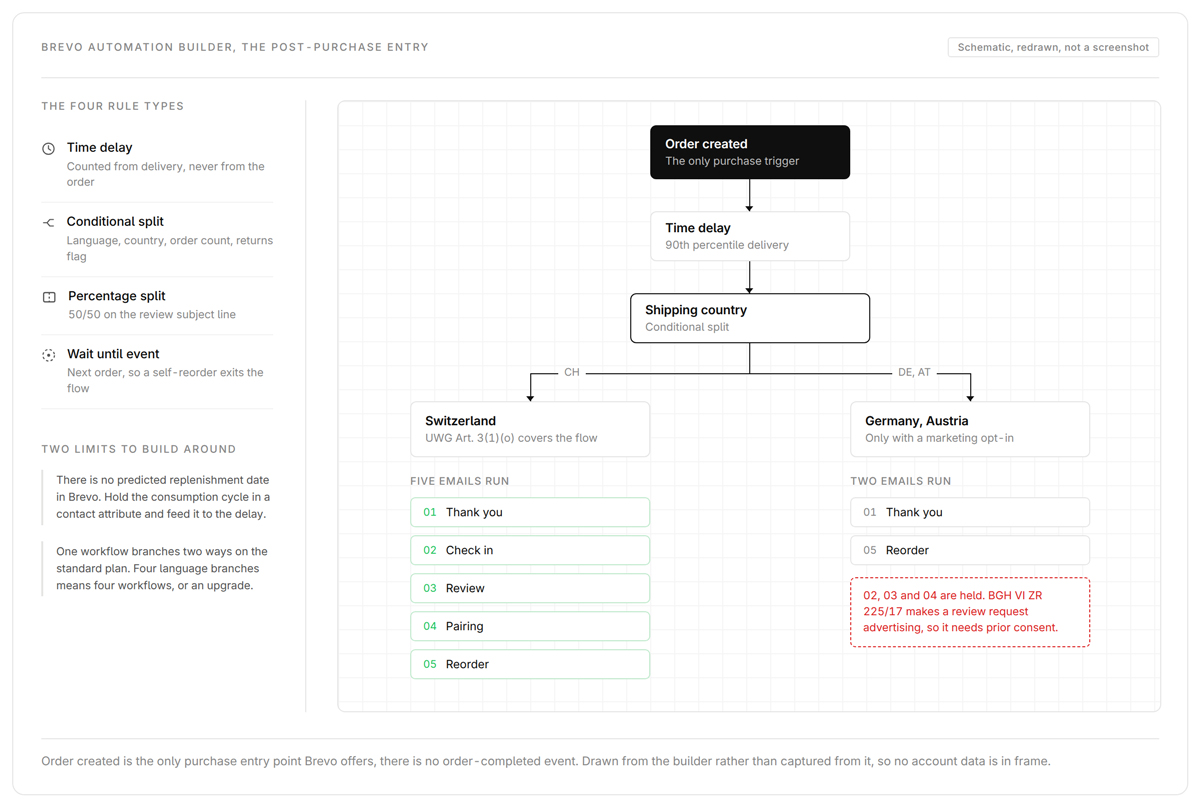
The entry point is the **Order created** trigger, which needs the Brevo tracker installed on the shop. There is no separate order-completed or product-purchased trigger. From there you have four rule types. Time delay, conditional split, percentage split, and wait until event. The build order below uses all four.
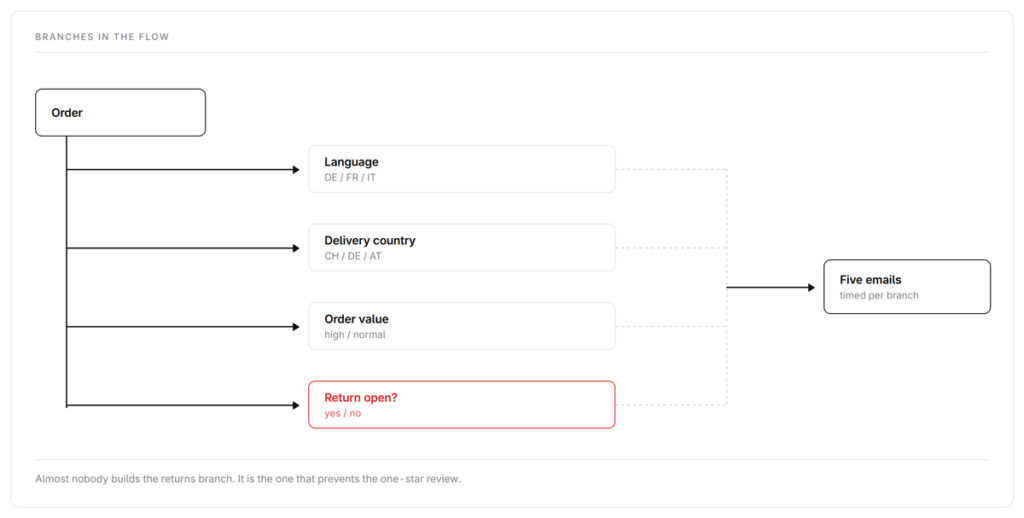
- 1. A conditional split on the contact's language attribute, straight after the trigger.
- 2. A conditional split on shipping country. The Swiss branch runs all five emails on the existing-customer basis. The German and Austrian branch runs emails 1 and 5 only, unless the contact carries a documented marketing consent flag.
- 3. A time delay sized to your 90th percentile delivery time, then email 1.
- 4. Conditional splits on order count, order value, and the returns attribute before emails 3 and 4.
- 5. A percentage split before email 3, 50/50, on the review request subject line. It is the one email in the flow with a single clean outcome, a review submitted or not, so the test reads without argument.
- 6. Wait until event on the next Order created, so a customer who reorders on their own never gets the reminder.
One limitation to plan around. Brevo has no native predicted-replenishment-date field, so you build it by hand, with a contact attribute holding the consumption cycle for the product category, feeding a time delay.
Whichever tool you use, store four fields on every contact. Consent source, timestamp, method (single opt-in, double opt-in, or purchase), and whether the objection notice was shown at the moment you collected the address. The last one is the field nobody stores and the one that decides a German case.
What to measure, and what good looks like
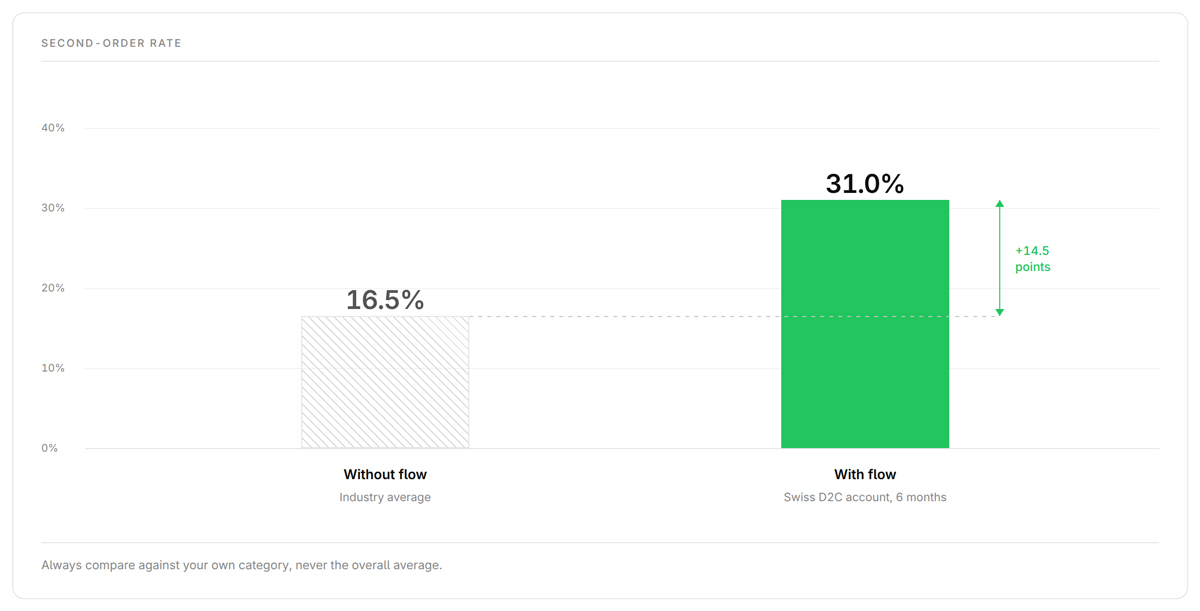
The flow exists to move one number, the share of first-time buyers who place a second order. Benchmark it against your own category rather than the 16.5% to 18.8% overall average [1] [2].
Five more numbers tell you where it leaks.
- Open and click per email: judge each email against its own benchmark and the job it was built for, never a flow average, and never judge the thank-you on revenue because it has none by design. A pairing email that out-opens the review request means you are asking for the sale before you have earned the goodwill.
- Revenue per recipient: Klaviyo's average post-purchase flow returns $0.38 while the top 10% return $5.27 [4]. A 14x spread.
- Review submission rate: roughly 68% of reviewers respond to the first request and 28% to a second sent seven days later [15]. If the second adds nothing, your timing is wrong, not your copy.
- Unsubscribe rate: a ceiling, not a target. Above 0.89% on the pairing email, your ask is too aggressive or too early [5].
- The gap: second-order rate of buyers who went through the flow against those who did not.
There is no Swiss or DACH post-purchase benchmark, Handelsverband.swiss publishes market size and no flow numbers [18], so build your own baseline first.
⚠️ Watch out Watch the complaint rate on emails 4 and 5. This flow is usually the only place a shop markets to people who never ticked a newsletter box. Gmail’s line is a 0.3% spam complaint rate, and sustained breaches cost you inbox placement on every send, not only this flow [17]. Turn it on for new orders only, and do not back-fill it across historic buyers on launch day.
Ready to build your second-order flow?
Shipping confirmations are not a post-purchase email flow, and the second order will not ask for itself. This is what we do at sakto. We build the sequence in Brevo, time the reorder email to your product’s real cycle, split it by country so your German customers get a version that holds up, and hand you the before-and-after number.
sakto is a Swiss email marketing agency, Brevo-first, built for e-commerce and B2B senders who want their email to work and stay on the right side of Swiss and German law.
Sources
[1] Bluecore Customer Growth Benchmarks Report (16 April 2024) · [2] BS&Co (email marketing agency, bsandco.us), Repeat Purchase Rate Benchmarks, 156’110 customers across 10+ verticals, 365-day lookback (14 February 2026), bsandco.us/blog-post/repeat-purchase-rate-benchmarks · [3] Bluecore Retail Ecommerce Benchmark Report (2022) · [4] Klaviyo 2025 Benchmark Report, AMER edition · [5] Omnisend email marketing benchmarks, 2025 data (13 May 2026) · [6] Omnisend 2026 Ecommerce Marketing Report · [7] Swiss UWG Art. 3(1)(o), Fedlex SR 241, with BAKOM guidance · [8] BGH VI ZR 225/17 (10 July 2018) · [9] KG Berlin 5 W 15/17 (7 February 2017) · [10] §7 Abs. 3 UWG (dejure.org) and IT-Recht Kanzlei · [11] BGH VI ZR 134/15 (15 December 2015) · [12] Revised Swiss DSG Art. 6 (1 September 2023) · [13] §174 TKG 2021 and the RTR ECG-Liste (WKO) · [14] Art. 40a ff. OR; EU Consumer Rights Directive · [15] PowerReviews review request timing research · [16] Brevo Help Center, triggers, actions and rules · [17] Google email sender guidelines · [18] Handelsverband.swiss with NIQ/GfK and Swiss Post (12 March 2026) · [19] Art. 23 UWG; steigerlegal.ch (16 July 2019)
*This article is general information, not legal advice. Swiss, German and Austrian marketing law is fact-specific. Check with a qualified specialist before acting.*